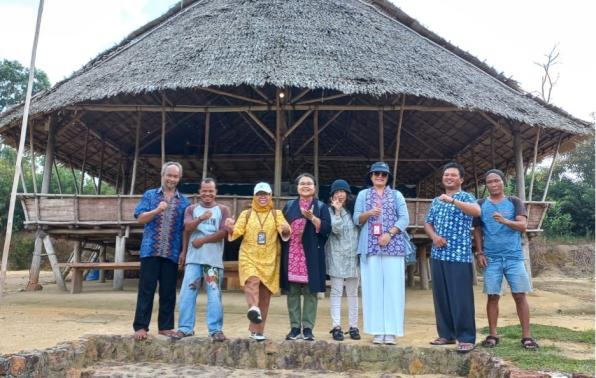
Air Abik, Bangka – The researcher team from the Institute of Indonesian Arts and Culture (ISBI) Bandung continued their working visit in Kepulauan Bangka Belitung Province by visiting Gebong Memarong customary village in Air Abik hamlet, Gunung Muda village, Bangka regency on Monday, 7/7/2025.
Funded by the Ministry of Research and Technology and Higher Education 2025, the team documented, studied, and explored the possibility of preserving and developing the local wisdom based on the locus of the research.
The team led by Prof. Dr. Sri Rustiyanti accompanied by Dr. Wanda Listiani, M.Ds, and Anrilia E.M. Ningdyah, Ph.D. were welcomed by traditional-law leaders of Gebong Memarong and hamlet residents.
The team had a chance to directly interact with them, observe the architecture of the typical house. Memarong traditional house consisted of seven stilt houses built on high wooden piles. It also uses bamboo and nipah or rumbia leaves.
The important part of the Begong Memarong is called Bale (hall) as the centre for meetings and other social activities. It is bigger than a house to accommodate many people. Besides customary meetings, it is also used for traditional ceremonies, studying, and an art workshop. It is located in the middle of the kampong, so everybody can reach it easily.
Prof. Dr. Sri Rustiyanti admired the continuity of the tradition in the modern era. “We’re impressed with how they preserve and pass on the noble values of their tradition to the young generation,” she said.
Another team member, Dr. Wanda Listiani, said that the design and function of the house represent the richness of local intellectuality.
The elder of the hamlet, Abok Geboi, said that the residents were still firmly guided by tradition, especially related to mutual cooperation and respect for nature and elders.
“We have a social system with the important role of elders in making decisions through Bale. All problems are discussed and solved in the spirit of mutual cooperation,” he said.
The team hoped to be able to document the traditional knowledge as part of preservation and dissemination effort. She also hoped that it could be a starting point for ISBI to conduct further study and even to develop a tradition-based curriculum for the Cultural Anthropology Department of the Faculty of Culture and Media of ISBI Bandung. (rz/sas)