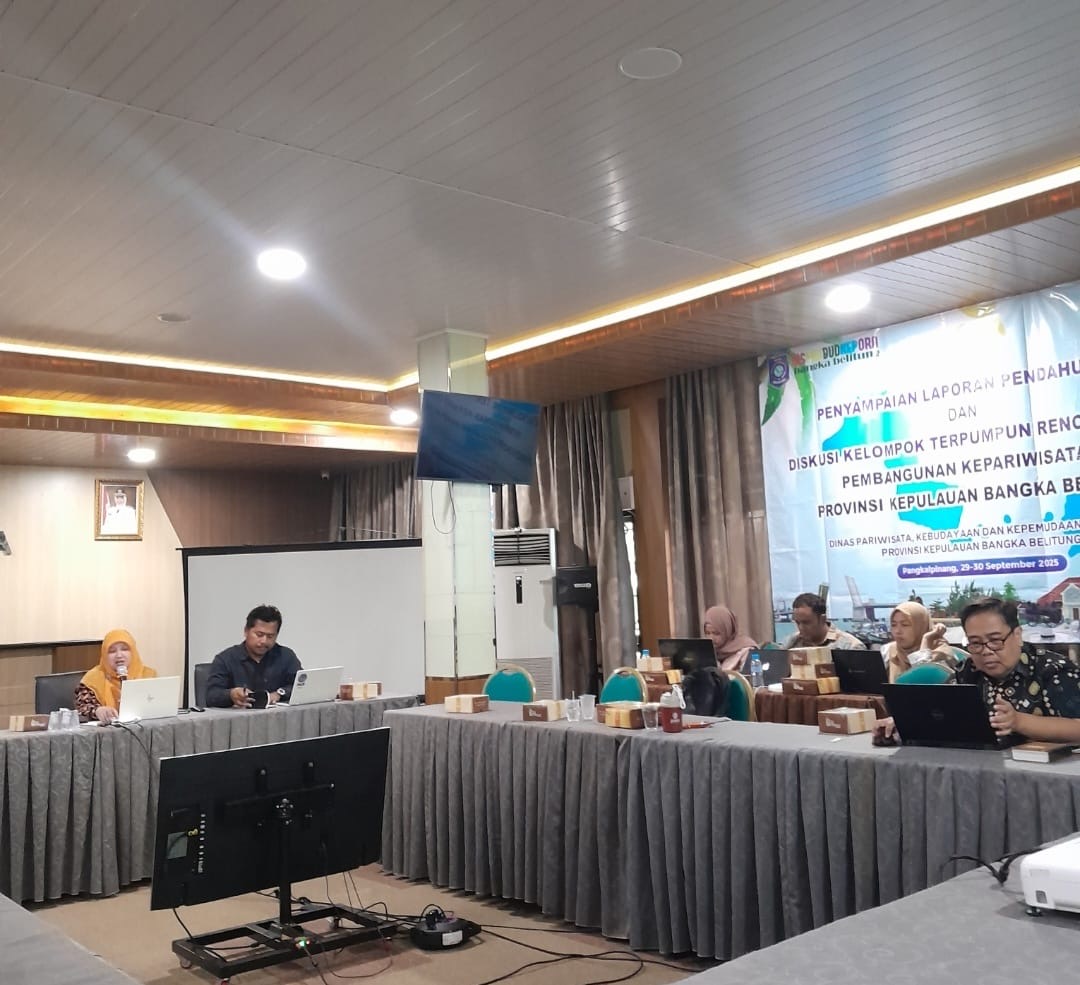
Pangkalpinang - The provincial Tourism, Culture, Youth and Sports (Disparbudkepora) of Kepulauan Bangka Belitung (Babel) held an FGD on the Provincial Tourism Development Master Plan (Ripparprov) on Monday and Tuesday, 29th – 30th September 2025, in the Meeting Room of the Provincial Development Planning office.
The FGD was officially opened by the Head of Disparbudkepora, Wydia Kemala Sari, and was attended by participants from various sectors, including tourism offices from regencies and city in the province.
The speakers in this FGD were a team from the Centre for Tourism Planning and Development (P2PAR) ITB Bandung, chaired by Yani Adriani, the provincial Development Planning Office, the Energy and Mineral Resources Office, Public Works and Spatial Planning Office, and the Maritime and Fisheries Office.
According to Yani, the Ripparprov for the 2016–2025 period would soon end, making it necessary to prepare a new document for the 2026–2045 period.
“This momentum becomes strategic as it coincides with other development planning documents at both national and regional levels, such as the National Long Term Development Plan (RPJPN), the Regional Long Term Development Plan (RPJPD), the Spatial Plan (RTRW), National Tourism Development Master Plan (Ripparnas), and Regional Tourism Development Master Plan (Ripparkab/kota). In addition, the Tourism Law Number 10 of 2009 is currently under revision, so the new regulations need to be accommodated in the upcoming Ripparprov,” said Yani.
Yani further explained that the preparation of Ripparprov Babel 2026–2045 aimed to produce a comprehensive, sustainable, and competitive long-term planning document. The main objectives included evaluating the achievements of Ripparprov 2016–2025, analyzing tourism performance and strategic issues for the 2016–2024 period, and formulating new tourism development vision, mission, goals, and targets.
Ripparprov, as also stated by Yani, was intended to establish strategies for the development of destinations, industry, marketing, institutions, and human resources in tourism, to organize tourism zoning that includes priority destinations and leading tourism villages, as well as to formulate indications for programs, activities, and mechanisms for implementation control.
"Finally, it will produce an academic document and a draft of regional regulation that will serve as the legal basis for tourism development in Babel," said Yani.
The FGD was closed by the Head of Disparbudkepora represented by the Head of the Tourism Destination and Marketing Division, Irwanto, on the second day. Irwanto expressed his appreciation for the active participation of all participants.
"The results of this forum are expected to serve as a blueprint for tourism development in Babel, which will then be implemented down to the regency/city and tourism village levels. This planning document is also targeted to become a local legal product in the form of regional regulations, either through provincial government proposal or the initiative of the Regional House of Representatives (DPRD)," explained Irwanto.
In addition, Irwanto suggested that as a follow-up to the FGD, it was necessary to establish a formal annual meeting between regencies/cities with a rotating system as the host to strengthen coordination, which has so far been informal.